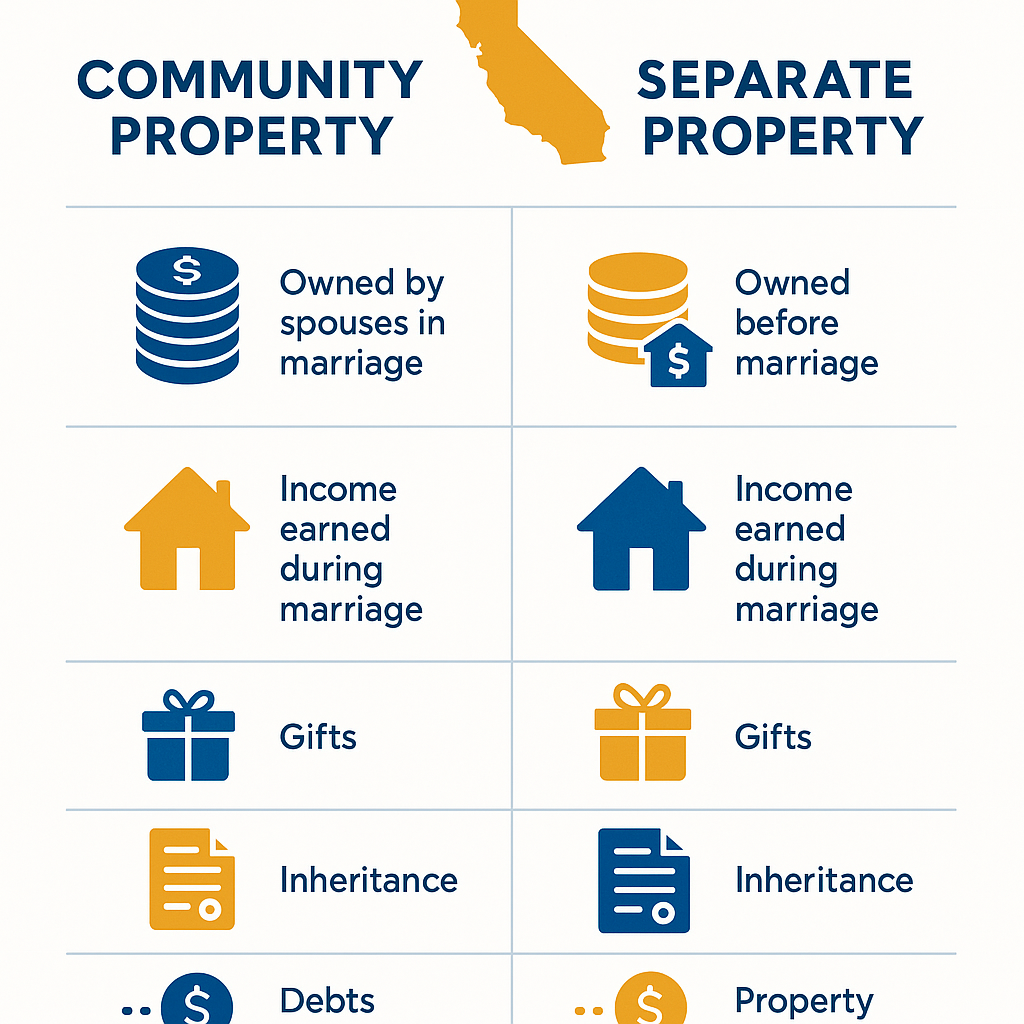
Understanding Community Property vs Separate Property in California is more critical than ever in 2025. With updated statutes, evolving court interpretations, and changing financial dynamics, classifying assets correctly can make or break your divorce outcome. Whether you’re entering a marriage, planning a separation, or just managing your financial future, this guide offers a comprehensive breakdown of what counts as yours, what counts as shared, and how to protect both.
California is one of the few states that follow a community property system. That means any income or assets acquired by either spouse during the marriage is considered jointly owned. But there are exceptions—particularly regarding gifts, inheritances, and property acquired before the marriage. Failing to distinguish between these properly can result in expensive legal battles and unintended asset division.
What is Community Property in California?
In simple terms, community property includes all assets and income earned during the marriage. This applies regardless of whose name is on the title or who earned the income. That includes:
-
Salaries and wages
-
Bank accounts funded during marriage
-
Homes purchased after the wedding
-
Vehicles acquired using marital earnings
-
Retirement contributions made while married
The default assumption under Community Property vs Separate Property in California is that both spouses equally own everything earned during the marriage unless proven otherwise. So, even if one partner has a significantly higher income, both are legally entitled to half of all community property in the event of a divorce.
What Qualifies as Separate Property?
Separate property, on the other hand, includes:
-
Assets acquired before marriage
-
Gifts received by one spouse
-
Inheritances specifically given to one spouse
-
Property acquired after legal separation
-
Compensation from personal injury settlements (in some cases)
However, keeping separate property protected requires proactive planning and documentation. For instance, if an inheritance is deposited into a joint account or used to improve the marital home, it may lose its “separate” classification through a process called commingling.
The Danger of Commingling Property
Commingling happens when separate and community assets are mixed. Once this occurs, it can be very difficult to prove which portion of the asset belongs to whom. For example, if you inherit $100,000 and use it as a down payment on a house titled jointly with your spouse, the courts may treat the entire house as community property unless detailed documentation proves otherwise.
In 2025, California courts are especially stringent on this issue. Maintaining separate accounts, detailed paper trails, and avoiding joint titling are critical in protecting your individual interests. Understanding Community Property vs Separate Property in California is essential before making major financial moves.
Transmutation: When Separate Becomes Shared
Another risk is transmutation. This refers to the process where separate property becomes community property through actions that suggest shared ownership. Examples include:
-
Adding your spouse to the title of a house you owned before marriage
-
Using community funds to pay off a separate debt
-
Re-titling a vehicle in both spouses’ names
California courts require written agreements to prove intent to transmute property. And in the absence of such agreements, the asset may legally shift classifications, putting you at risk of losing half its value in a divorce.

Date of Separation: The Critical Line
The moment of legal separation draws a line between community and separate property. Any income or assets acquired after this date are generally considered separate property. However, determining the exact date of separation isn’t always straightforward.
Courts look at both physical separation and intent. If spouses are still living under one roof but no longer functioning as a couple, the court may still recognize that as separation. This date is essential for determining ownership, and it often plays a decisive role in Community Property vs Separate Property in California litigation.
Retirement Accounts and the Role of QDROs
Retirement accounts are among the most contested assets during divorce. Any portion of a retirement plan earned during the marriage is considered community property. To divide this fairly, couples must use a Qualified Domestic Relations Order (QDRO).
A QDRO ensures that retirement benefits can be split without incurring early withdrawal penalties or tax consequences. You can learn more about QDROs from the IRS official page.
Using Prenuptial and Postnuptial Agreements to Define Property
A clear prenuptial or postnuptial agreement is one of the best ways to override default community property assumptions. These agreements can define which assets will remain separate and which will be treated as community property in the event of divorce.
In 2025, California courts continue to enforce valid prenups as long as:
-
Both parties entered into them voluntarily
-
The agreement was signed with full financial disclosure
-
The terms are not unconscionable
These agreements must be updated as finances evolve. Without them, you’re fully subject to California’s default Community Property vs Separate Property in California rules.
Business Ownership: A Murky Area
If one spouse owns a business, determining how much of it is community property can be extremely complicated. Courts often apply the Pereira or Van Camp methods to evaluate business value before and after the marriage.
The more actively involved the spouse is in growing the business during the marriage, the more likely the appreciation will be considered community property. Documentation of time, investments, and growth metrics will be essential in court.
Real Estate and the Family Home
Real estate is one of the most emotionally and financially valuable assets in divorce. If a home was acquired during the marriage, it is presumed community property. Even if one spouse paid the down payment using separate property, community contributions (like mortgage payments from joint income) can result in partial or full community classification.
Understanding this nuance is key to successfully navigating Community Property vs Separate Property in California cases involving homes.
Estate Planning After Divorce
Failing to update estate plans post-divorce can result in unintended outcomes. Many people forget to change beneficiaries on retirement accounts, life insurance policies, or even wills—accidentally leaving large sums to an ex-spouse.
Make sure to:
-
Update your trust or will
-
Change beneficiary designations
-
Reassign durable power of attorney
-
Revise healthcare directives
Even if the divorce nullifies spousal rights in theory, failure to update paperwork can lead to unnecessary legal challenges later on.
Past Behavior’s Influence on Custody and Asset Division
Your financial and personal behavior during the marriage can impact both asset division and child custody. For example, substance abuse, financial irresponsibility, or abandonment may influence how a judge awards both custody and property.
To explore this further, review how past addiction can impact custody outcomes in California—a factor that often intertwines with financial settlements.
Gifts and Inheritances: Often Misunderstood
Many spouses incorrectly assume that any gift given during the marriage is shared property. However, if a gift or inheritance is given to one spouse alone and is kept separate from community assets, it remains separate property.
The key is to avoid mixing it with community resources. If a cash gift is deposited into a joint account, or if it’s used for joint purposes, it may lose its protected status.
If you’re unsure, see this detailed breakdown of how California courts classify marital and separate property to avoid losing what was rightfully yours.
Proactive Steps to Protect Your Property
To avoid surprises, take these steps early in your relationship:
-
Maintain separate accounts for separate assets
-
Avoid titling property jointly unless intentional
-
Keep detailed records for inheritances and gifts
-
Draft a valid prenup or postnup
-
Don’t commingle income or funds unless you want shared ownership
These precautions can shield you from legal disputes and ensure financial clarity.
Final Thoughts on Community Property vs Separate Property in California
Whether you’re planning a marriage, a divorce, or simply want to protect your legacy, understanding the laws around Community Property vs Separate Property in California is non-negotiable. With proper planning, documentation, and awareness, you can confidently protect your personal and marital assets.
For additional guidance, refer to the California Courts’ self-help divorce resources to stay compliant and informed.
Leave a Reply